Why This Matters: Breaking Down Silos
Historically, SPP (and many regions) handled transmission planning (e.g., its annual Integrated Transmission Plan) and generator interconnection (GI) studies separately. This siloed approach led to inefficiencies, prolonged queues, duplicative studies, and uncertainty for developers—often resulting in projects stalling or abandoning the queue.
The CPP integrates these processes into one recurring three-year planning cycle that holistically forecasts both load growth and new generation needs over 10- and 20-year horizons. It proactively identifies optimal transmission solutions and pre-planned interconnection locations (Planned Interconnection Locations or PILs) with sufficient capacity, giving developers clearer signals upfront.
Key Features of the Streamlined CPP
- Faster Interconnection Timelines: Interconnection agreements targeted in approximately 9–10 months—more than 65% faster than the national average. The queue cluster window shrinks from 11 months to just 2 months, with a single Decision Point (after which financial security is largely non-refundable) and a consolidated 180-day study period combining previous phases.
- Upfront Cost Certainty: Introduction of a Generalized Rate for Interconnection Development-Contribution (GRID-C)—a standardized rate for system upgrade costs, published in fall 2026. Developers gain predictable pricing before committing.
- Long-Term Holistic Planning: The 20-year CPP assessment (on a three-year cycle) models multi-driver needs (load + generation), reduces duplicative spending, lowers congestion costs, and optimizes transmission portfolios for hundreds of millions in potential savings.
- First CPP Window: Opens in April 2026.
FERC Commissioners described the CPP as a “bold step” and “revolution” that aligns with broader goals in Order No. 1920 for long-term regional transmission planning. They encouraged other RTOs/ISOs to explore similar reforms.
Benefits for Stakeholders
- Generation Developers (especially renewables and storage): Reduced uncertainty, faster timelines, and better locational signals speed up project viability.
- Utilities and Load-Serving Entities: More efficient grid planning, lower long-term costs, improved reliability, and enhanced resource options.
- Consumers: Potential savings from optimized infrastructure and reduced administrative overhead (SPP estimates over $3 million annually in planning cost reductions).
- Clean Energy Transition: Accelerates integration of wind, solar, and other resources while maintaining reliability.
The proposal received broad stakeholder support, including from environmental groups like the Sierra Club and Natural Resources Defense Council, during development and FERC review.
Broader Context and Next Steps
This approval builds on FERC’s Order No. 1920 (and subsequent clarifications), which mandates long-term regional transmission planning across the U.S. SPP’s CPP serves as an early, innovative implementation that goes further by tightly linking planning with interconnection.
SPP anticipates publishing the first GRID-C rate this fall. Other regions are watching closely as FERC reviews compliance filings for Order No. 1920.
For full details, refer to FERC Docket Nos. ER26-414-000 and ER26-414-001, or SPP’s official announcement.
This development underscores ongoing efforts to modernize the U.S. grid for a high-growth, low-carbon future. Stay tuned for updates as implementation begins.
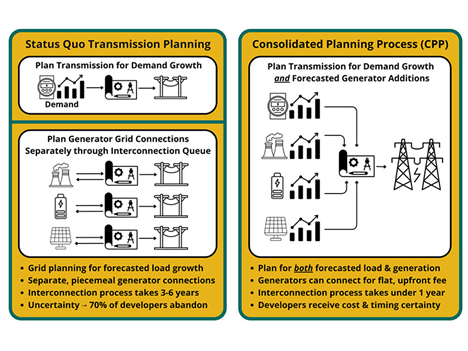
“Status Quo vs. Consolidated Planning Process (CPP). SPP’s new framework integrates transmission planning and generator interconnection, dramatically cutting timelines and providing upfront certainty for developers.”
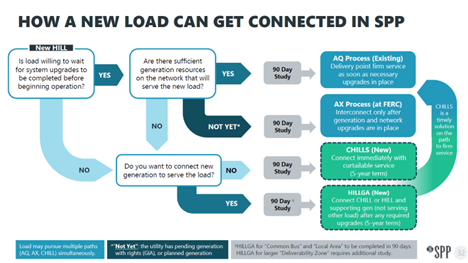
Example of streamlined connection pathways under SPP’s evolving planning framework, aligned with CPP goals.”
References
Southwest Power Pool. “FERC Approves SPP’s Groundbreaking Transmission Planning Proposal.” March 16, 2026.
https://www.spp.org/news-list/ferc-approves-spp-s-groundbreaking-transmission-planning-proposal/
Federal Energy Regulatory Commission. Commissioner David Rosner’s Concurrence, Docket Nos. ER26-414-000 & ER26-414-001. March 13, 2026.
https://www.ferc.gov/news-events/news/commissioner-rosners-concurrence-southwest-power-pool-inc
(Source of the official “Status Quo Transmission Planning” vs. “Consolidated Planning Process (CPP)” diagrams)
Federal Energy Regulatory Commission. Commissioner Judy Chang’s Concurrence, Docket Nos. ER26-414-000 & ER26-414-001. March 13, 2026.
Utility Dive. “FERC approves SPP’s consolidated interconnection and transmission planning overhaul.” March 17, 2026.
https://www.utilitydive.com/news/ferc-spp-consolidated-interconnection-transmission-planning/814915/
Sierra Club. “Historic Support to Expedite New Power in Southwest Power Pool.” March 2026.